Auerbach in images: From the Homeric and Biblical Epic to Western Representation
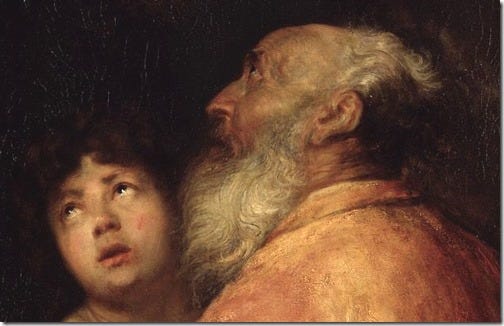
Mimesis and Ulisses Scars chapter
In Mimesis: The Representation of Reality in Western Literature, especially in the opening chapter, “Odysseus’ Scar,”Eric Auerbach compares Homer and the biblical tradition. Within epic representation, it is possible to identify two different narrative structures and modes of construction: the Biblical epic and the Homeric epic. Based on these concepts developed by the author, I intend to analyze visual artworks throughout this text in order to understand the means and instruments through which artists construct their paintings around these themes.
IntroductionThe representation of the epic in the history of art constitutes one of the main paths for understanding how societies have organized narratives about heroism, destiny, suffering, and transcendence. Since the Greek tradition, especially through the epics attributed to Homer, the epic has been connected to the representation of extraordinary events, heroic figures, and conflicts that surpass individual experience. However, when these literary narratives are transferred into images, painting does not merely illustrate a story: it reconstructs the event visually through the forms of the body, gesture, composition, light, expressions, colors, and symbols.
Through Eric Auerbach’s analysis in Mimesis, it is possible to understand a fundamental difference between Homeric narrative construction and the biblical tradition. While the Homeric model presents events through a clear exteriority, with characters defined by action, the body, and the immediate presence of events, the biblical text introduces a dimension of depth marked by concealment, inner conflict, and the relationship between the individual and divine destiny. These two narrative structures profoundly influenced Western visual tradition, especially through the encounter between classical heritage and Christian culture.
This research investigates how painting absorbed and transformed these two narrative structures in the construction of the epic image. For this purpose, representations of episodes from the Iliad and biblical traditions will be analyzed, observing how different artists visually constructed figures such as Achilles, Odysseus, Adam, Abraham, Isaac, David, Job, Jeremiah, and Moses. The objective is to understand how painting articulates the heroic monumentality of the classical tradition with the spiritual interiority of the biblical tradition, creating images in which the epic does not depend only on the representation of great events, but also on the ability of the artwork to reveal universal human conflicts.
In this sense, the analysis seeks to understand painting as a space of transformation of narrative: between what is visible and what remains hidden, between heroic action and inner experience, between myth, history, and the symbolic dimension of the image.
Research QuestionHow does Western painting visually construct the concept of the epic through the relationship between the Homeric tradition and the biblical tradition, transforming literary narratives into images capable of representing heroism, conflict, suffering, and transcendence?
Or, in a more specific formulation:
In what ways do artists, when representing episodes from the Iliad and biblical narratives, articulate elements of the Homeric epic — such as the body, action, monumentality, and narrative clarity — with elements of the biblical epic — such as interiority, silence, destiny, and spiritual conflict — in order to construct a visual narrative specific to painting?
According to Auerbach, Homer presents:clarity;
timelessness;
a plane of action;
exteriority;
visible action;
characters fully presented: everything is visible and completely expressed;
pastoral and everyday life;
an intact heroic body, grand through the detailed representation of deeds;
legendary description;
a fixed aristocratic social order.
However, Auerbach also demonstrates that Western tradition, through the Old Testament and the Bible, incorporates another dimension:
inner suffering;
the effect of historical truth;
concealment of human and divine action;
the depth and intensity of human actions;
psychological conflict, density, and interior depth;
abandonment and divine exaltation;
human drama;
exaltation and humiliation;
an archaic popular democracy.
Thus, in the biblical epic, epic representation is not only about greatness: it is also about tension.
However, could these biblical and epic textual observations proposed by Auerbach contain mixed examples in painting? Since painting also develops through the reabsorption of Homeric readings, it incorporates textual representations within expanded historical periods, in which processes of image construction evolve through different mentalities, including those already inserted within a Christian worldview. Could epic representations in painting simultaneously absorb these two narrative and visual elements?
The answer I propose through this exhibition is yes.
This process can be analyzed in paintings, as well as through intellectual figures such as Saint Thomas Aquinas, who understood the necessity of absorbing what was considered pagan tradition in order to later re-Christianize it.
This movement also occurred within the development of the Catholic Church itself, which incorporated elements of Roman tradition, reinterpreting Rome as part of a history of salvation and redemption, in which pagan elements were re-signified and absorbed into Christian practice.
We will observe the use of these two epic dimensions in paintings based on themes represented literarily by Auerbach, through a small visual index of his text.
For Auerbach, the Homeric element lies in tension: “the relaxation of the listener occurs through the interweaving of various elements from the past in order to complete the narrative of Odysseus’ encounter with Penelope through the intensification of his scar.”
For the author, in literary writing:
“The incomplete filling of the present is part of an interpolation that increases tension through delay; it is necessary that it does not remove from consciousness the crisis whose resolution must be awaited with tension, so as not to destroy the suspension of the state of mind; the crisis and tension must be maintained, remain conscious, in a secondary background.” (AUERBACH, 2013, p. 3)
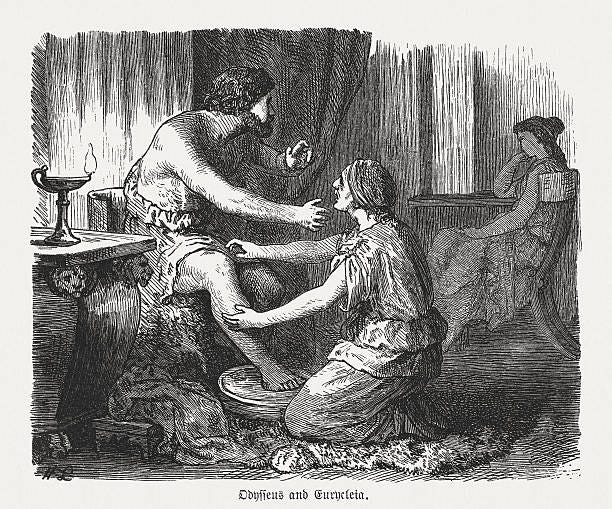
Ulysses Recognized by His Nurse Eurycleia, Heinrich Leutemann (1824–1905), “Ulysses’ wet nurse Eurycleia recognizes her Lord”
The recognition of Ulysses by his nurse Eurycleia can be understood within the framework of the Homeric epic. The scene represents the moment in which Ulysses is recognized through his scar, a central episode in the Odyssey. The hero’s identity is revealed through a visible bodily element. The Homeric narrative transforms memory into concrete image: the scar functions as material proof of the past.
In relation to Auerbach, we can observe the externalization of memory; nothing remains hidden. The past is brought into the present through description. The body itself reveals the hero’s history—in this case, the scar. It is interesting that within this composition there is also a subtle psychological tension regarding a future action, as Penelope is positioned in the shadow of a secondary room, while Ulysses appears focused on what will be his next action.
The use of this delaying element, for the author, is related to the epic process in opposition to the tragic, a discussion also present in Goethe and Schiller.
Thus, unlike a narrative that builds tension directly toward a final goal, Schiller and Goethe elevate the Homeric process: they “raise the Homeric process to the status of a general law of epic poetry” (GOETHE; SCHILLER apud AUERBACH, 2013, p. 3).
However, the author also reiterates that there are epic works independent of this delaying element, which produce a sense of:
“merely the calm existence and action of things according to their nature” (AUERBACH, 2013, p. 3)
and whose purpose is:
“present in each point of its movement” (AUERBACH, 2013, p. 3)
From the observation of the effect of retardation, both authors seek the epic effect influenced by Antiquity. As Auerbach also notes, there is an attempt by ancient authors to ensure that nothing mentioned in the narrative remains without a narrative closure (AUERBACH, 2013, p. 3).
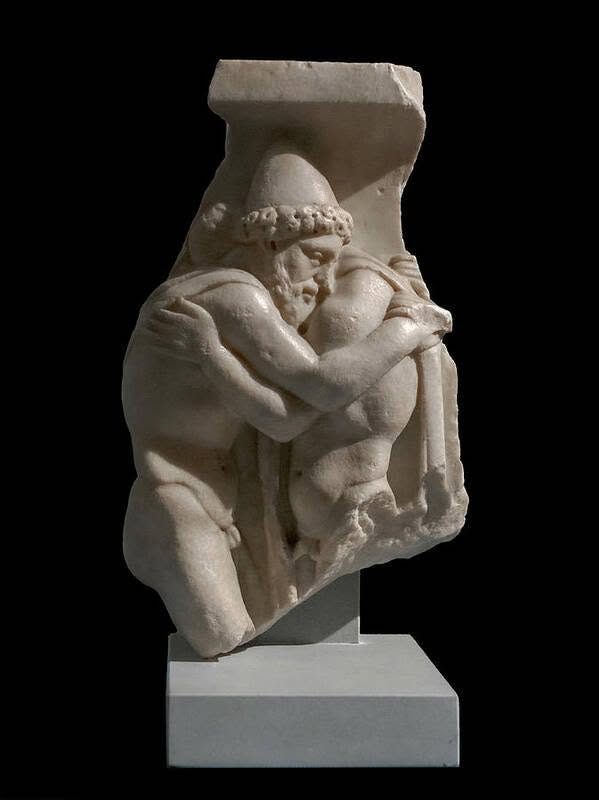
Ulysses and His Father Laertes (Fragment of a Roman sarcophagus, 2nd century AD, unknown author)
Fragment of a Roman sarcophagus in Luna marble, 2nd century AD (Museu Barracco). Ulysses, wearing his characteristic conical hat, embraces his elderly father, Laertes, king of Ithaca. The image represents the reunion between father and son after Ulysses’ return to Ithaca. The gesture of the embrace organizes the entire narrative: recognition occurs through physical presence.
From a Homeric perspective, emotional meaning is expressed through gesture—the son embracing the father. Identity is revealed through the action of the embrace; human relationships are presented directly. Feeling is not psychologically investigated but rather shown in the foreground, in full visibility.
Nothing is diminished; the digression of the scar unfolds through an exteriority of phenomena and processes that do not emerge from a blurred memory, but from a clarity that also liberates images of the hero’s youth (AUERBACH, 2013, p. 4).
This characterizes the Homeric style for Auerbach as:
“to represent phenomena in a fully completed manner, tangible and visible in all their parts, clearly defined in their spatial and temporal relations. The same applies to psychological processes: nothing of them should remain hidden or unexpressed. Without restraint, even in moments of passion, Homeric characters reveal their inner life in speech; what they do not say to others, they say to themselves, so that the reader may know it.” (AUERBACH, 2013, p. 4)
Achilles and Hector
The representation of the duel between Achilles and Hector concentrates the epic within heroic action. The conflict is externalized through the bodies of the warriors, their weapons, and the act of combat itself. Achilles represents individual glory and force; Hector embodies honor and collective duty.
The characteristics of this scene are: clear conflict; characters defined by their values; and action as a construction of destiny. Even the way the artist positions them in a posture resembling a natural rest evokes the everyday beauty that also structures the Homeric epic, where Achilles and Hector engage in dialogue before the final battle, while weapons and armor are simultaneously present as extensions of their heroic condition.
The logic of the scene is inscribed in the heroic bodies of warriors who, even when nude, do not present vulnerability; instead, they appear composed, resting in anticipation of the unfolding of their destiny.
For Auerbach, Hector and Achilles speak both before and after the fight, and neither speech is charged with fear or rage to the point that the instruments of logical articulation in language become disordered:
“Hector and Achilles speak before and after the fight; and no speech is so charged with fear or anger that in it the instruments of logical articulation of language are absent or disordered...” (AUERBACH, 2013, p. 5)
It is a mutual and fluid correlation, perfectly and synthetically completed, without fragmentation. There is great movement and rhythm; everything is illuminated rather than partially illuminated. Nothing remains hidden or deep in the sense of concealed interiority; phenomena occur only within the present spatial and temporal plane. For Auerbach, everything appears in the foreground (AUERBACH, 2013, p. 5).
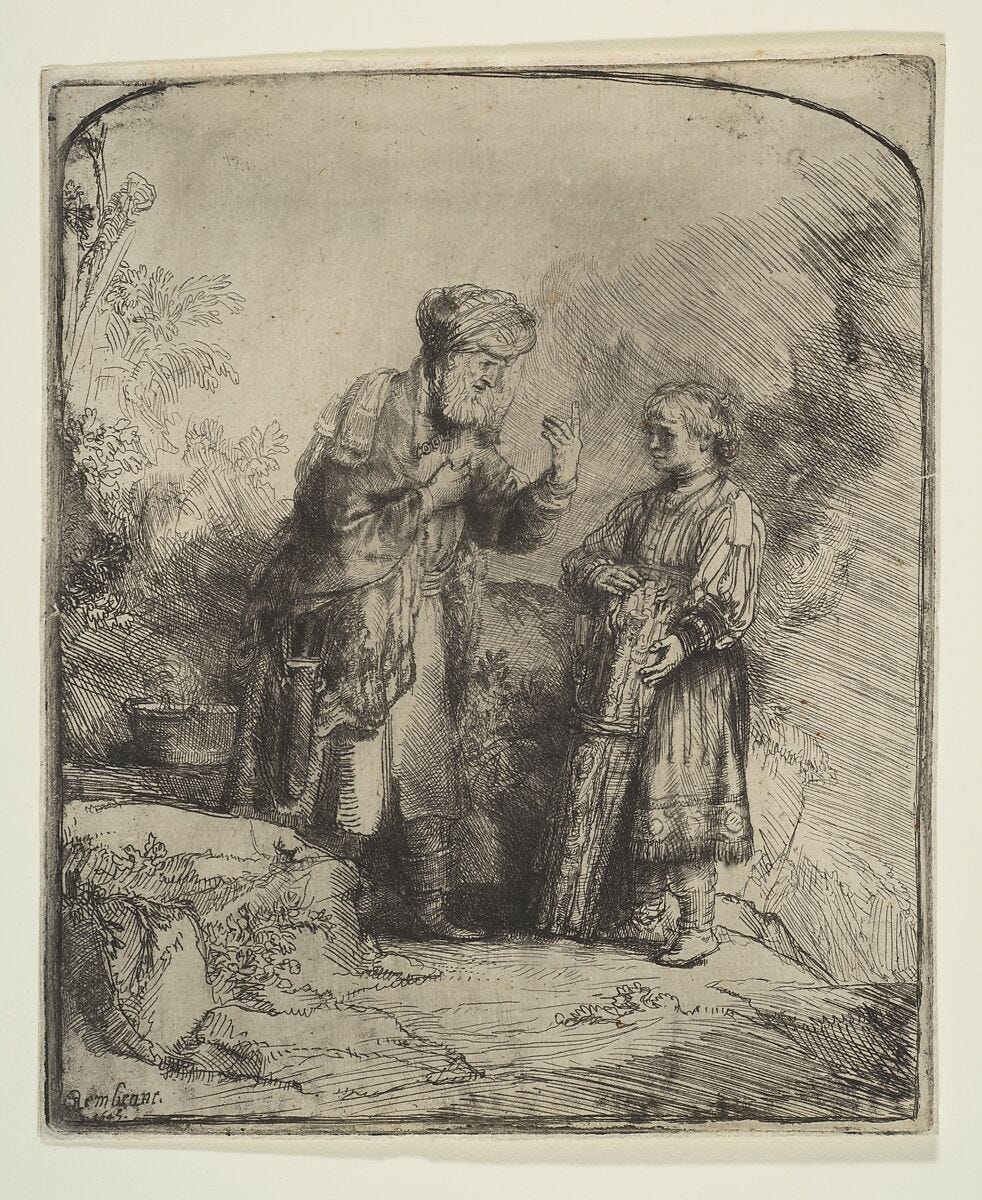
Abraham and Isaac — Rembrandt van Rijn (Dutch, 1645)
In this work by Rembrandt, we clearly observe what Auerbach identifies as the so-called biblical epic. The composition emphasizes the emotional resistance of the father: Abraham appears divided between the divine promise and the human bond with his son. The innocence and participation of the firstborn are also evident, expressed in his question about where the lamb for the sacrifice would be.
The father points toward the sky while keeping his hands close to his chest, a gesture that reinforces his inner conflict. The use of hatching creates variations of shadow and light, producing a nebulous atmosphere that intensifies the drama of the scene. This representation reveals multiple layers of consciousness, inner conflict, and spiritual tension.
Nothing similar occurs with Hector in relation to his duty as a warrior, nor with Agamemnon in the sacrifice of his own daughter within the Greek epic tradition. In these cases, the characters are not presented with the same psychological and spiritual depth that characterizes Abraham in the biblical narrative.
The author of Mimesis begins a long textual comparison between the narrative elements present in the account of Abraham and Isaac and those of Homeric texts. He identifies differences such as the concealment of details, the absence of a clear definition of time and space in the biblical narrative, as well as the presence of an oppressive tension in the plot, in contrast to the Homeric narrative, which carefully details the entrance and exit of deities, their proper naming, and the precise perception of time and space.
Even in the face of these differences, Auerbach agrees with Schiller in affirming that this “abduction of spirit” present in the biblical account also possesses an epic character (AUERBACH, 2013, p. 8).
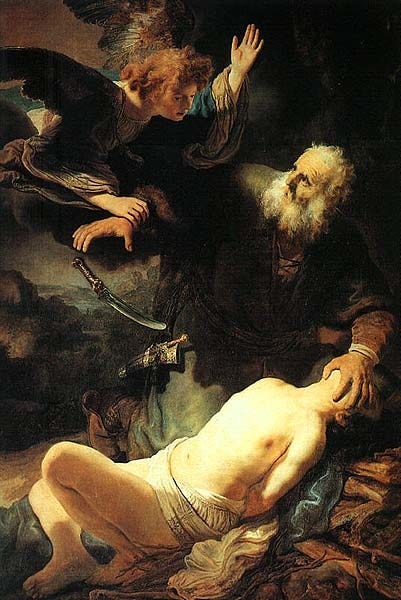
The Sacrifice of Abraham — Rembrandt
Rembrandt’s painting The Sacrifice of Abraham, when observed through Auerbach’s reading, can also be understood as an expression of the biblical epic. The image reveals the psychological drama of the figure, since the moment represented is not merely an external event, but a profound inner crisis.
The angel interrupts Abraham at the very instant of the sacrifice. The father, overwhelmed by shock, recoils in terror, while the son lies bound, his face covered by his father’s hand. The sublime dimension of redemption and divine grace emerges precisely from the willingness to endure suffering and sacrifice. The trial imposed on the character reaches an extreme level, demanding the renunciation of what is most precious to him.
Rembrandt constructs this tension through strong contrasts of light and shadow. Illumination falls upon Isaac’s body and the figure of the angel, while Abraham’s garments remain enveloped in darkness, although his face receives a concentrated light that reveals both shock and sudden awakening. In this instantaneous moment, divine intervention interrupts the impending tragedy and restores a new clarity to the scene. Thus, the painting visually translates what Auerbach identifies in the biblical narrative: psychological depth, inner conflict, and spiritual tension that confer a singular human density to the story.
While in Homeric texts there is an externalization of thought—allowing nothing implicit to remain hidden but instead exposing what is expressed—the biblical account employs more direct forms of expression, concealing motives and intentions in Mimesis (AUERBACH, 2013, p. 8).
This relates to representations of remembrance and the luminosity of the hidden, in which what is concealed can be revealed through the construction of light. The painter often uses light to determine the unfolding of temporal sequencing in order to narrate the story visually.
The contrasts between the biblical epic text and the Homeric text are thus articulated as follows:
“On the one hand, completed phenomena, uniformly illuminated, defined in time and space, linked together without gaps, in the foreground; thoughts and feelings expressed; events unfolding slowly and with little tension. On the other hand, only what is formally complete in the manifestations is relevant to the goal of action; the rest remains in darkness. The climactic and decisive points for action are the only ones emphasized, what lies between them is inconsistent, time and space are undefined and require interpretation; thoughts and segments remain unexpressed: they are only suggested through silence and fragmentary speech. The whole, directed with maximum and uninterrupted tension toward a destiny, and therefore much more unified, remains enigmatic and charged with secondary layers.” (AUERBACH, 2013, p. 8)
Abraham and Isaac (The Sacrifice of Isaac / Opferung Isaaks / Le Sacrifice d’Abraham), c. 1637/1638 — Jan Lievens (Dutch Baroque painter, 1607–1674) Oil on canvas, 180 × 136 cm (70.9 × 53.5 in.), Herzog Anton-Ulrich Museum, Braunschweig, Germany
In Jan Lievens’ painting Abraham and Isaac, the biblical epic reading emerges through the way the composition emphasizes the father’s emotional resistance. Abraham appears divided between the divine promise and the human bond. Here, what Auerbach identifies in the Bible becomes clearly visible: multiple layers of consciousness, inner conflict, and spiritual tension.
In the painting, these elements are expressed through the use of light on the faces of the figures, while certain areas remain concealed. Isaac’s hair, for instance, dissolves into the darkness of the background composition, and his eyes shine at the same time as father and son are depicted in an embrace charged with emotional intensity.
The expression of age, the beard, the carefully constructed wrinkles, and the sun-darkened tone of the skin reveal a transformed man rather than an intact hero.
However, Auerbach emphasizes, in distinguishing between foreground actions in Homeric texts and background actions in biblical texts, a fundamental point: the more concealed the divine presence appears in the biblical narrative, the greater the depth that emerges behind this concealment. The richness of biblical characters is connected to their sense of consciousness, time, and destiny, presenting deeper layers of feeling and thought in comparison to Homeric characters and divinities (AUERBACH, 2013, p. 9).
The character of Abraham is not only defined by the present moment or by his character traits, as in the case of Achilles—marked by audacity and pride—but also by his past history. He recalls a divine promise present within his consciousness. In his dramatic interiority, he is torn between indignation and hope, and his obedience unfolds across multiple layers of action and awareness, something that would not occur in the same way with Homeric characters (AUERBACH, 2013, p. 9).
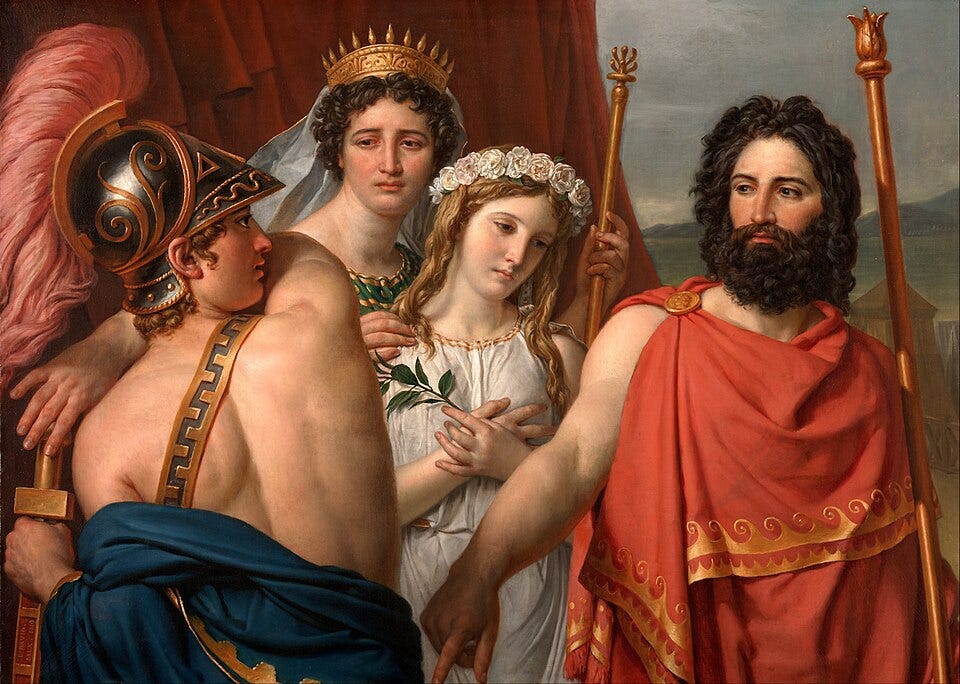
The Wrath of Achilles — Jacques-Louis David (1819)
In The Wrath of Achilles (1819), by Jacques-Louis David, we find a literal modern attempt to reconstruct the epic. The characters are presented with clarity; the gestures are theatrical; the composition is balanced; and the bodies, idealized and heroically sculpted, appear without any concealment. Instead, a translucent light traverses the skin of all the figures, making each gesture in the scene legible.
Agamemnon appears with his fingers pointing downward, commanding and sustaining the sceptre of authority beneath his red mantle. Odysseus seems to restrain, at his fingertips, the desire for vengeance over the loss of Briseis. Athena, hesitant and sorrowful, pleads that no bloodshed be provoked by the offended warrior. Briseis, in turn, bears her fate with quiet dignity and sadness, resigned to her condition.
Yet there is an important difference: David already introduces a modern element—the psychology of conflict. Each character appears to interrogate themselves internally—especially the goddess and the enslaved woman. The female figures reveal greater emotional complexity, while only Agamemnon and the hero present themselves in more defined, univocal gestures and emotions.
Achilles is not merely a hero; he is a subject in rupture. The subject of action.
“Homer, at most, presents the conscious doubt between two possible modes of action; in all other respects, the multiplicity of psychic life appears in him only in succession, in the alternation of passions, whereas the Jewish authors succeed in expressing the simultaneously superimposed layers of consciousness and the conflict between them.” (AUERBACH, 2013, p. 10)
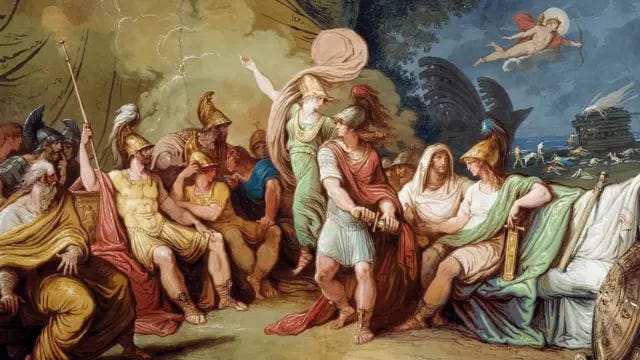
The Dispute between Achilles and Agamemnon — Felice Giani (1758–1823)
The painting The Dispute between Achilles and Agamemnon, by Felice Giani, presents several interesting Homeric characteristics. One perceives the clarity with which the characters express their satisfaction or dissatisfaction in relation to the events unfolding. At the same time, some remain calm and detached in their reactions. Agamemnon, for instance, is depicted wearing a fine suit of armor and holding a sceptre, clearly indicating his hierarchy and power. Other warriors are seated in luxurious garments, conversing in a posture of rest.
Only a few warriors perceive Achilles’ fury as he places his hand on his sword, yet they do not react to an internal psychological process, but rather to an external action that is visibly manifested. Even Achilles himself, driven by rage, calmly and rationally looks toward Athena, who gently guides the unfolding of the war narrative, wrapped in light fabrics moved by the wind.
There is something light and clear in the way the characters develop amid the drama of a war that unfolds in the background. The conflict arises from honor and power. Achilles is defined by passion and pride, but there is no deep exploration of this anger in psychological layers; instead, it is expressed through external gestures visible to all.
This is an external tension: hero against hero, rather than a conflict of inner consciousness or multiple hidden layers of history behind a gesture.
For Auerbach, Homer constructs a narrative of enchantment—invented and well crafted—in which the pleasure of lived reality is emphasized, in joy, without concealment or hidden didactic meaning. Even the confrontation with tragedy, in verse 360, which speaks of aging caused by misfortune, occurs through a natural acceptance.
The opposite occurs in biblical accounts. Sensory enchantment:
“is achieved through ethical, religious, inner events, which are the only ones that interest them, and are realized in the sensible material of life.” (AUERBACH, 2013, p. 11)
With the intention of constituting an absolute historical truth, the biblical narrative presents a truth that imposes itself as the only possible world, in contrast to the narrative openness present in Homer (AUERBACH, 2013, p. 11).
Homer enchants, pleases, and seeks to offer the audience a narrated reality; it makes one forget reality itself for a few hours through the delight of narration.
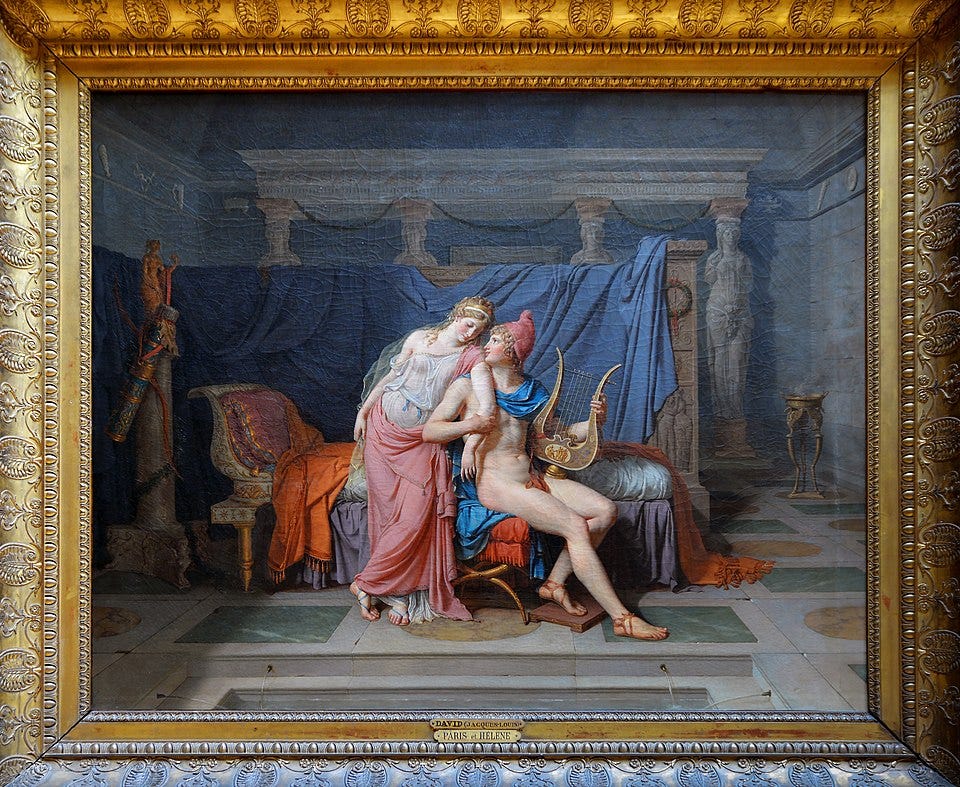
The Love of Helen for Paris — Jacques-Louis David
The Love of Helen for Paris, by Jacques-Louis David, allows for a reading close to Auerbach’s interpretation: a humanized Homeric epic. The narrative shifts the war toward the realm of human passions. The conflict arises from desire, yet it still belongs to the heroic universe of the Iliad.
We see the two lovers displaying their physical beauty and the clarity of their mutual desire and interest. Light illuminates the entire composition, making the royal chambers fully visible and reinforcing the noble condition of the characters who fall in love. Helen reclines as she is embraced by Paris, who holds an instrument with which he appears to declare his love. Paris’ gaze is entirely directed toward his beloved, and his amorous destiny shows no fear, anguish, or concern about betrayal.
The action unfolds within a single emotional plane, without deeper psychological layers or hidden inner conflicts. Feelings are presented in a clear and visible manner, characterizing a narrative that privileges the externalization of passions and gestures.
Biblical texts, on the other hand, dominate: if not accepted, the individual is placed in a position of rebellion. They are texts grounded in promise and doctrine, which opens space for a second, hidden meaning, allowing the text to continually yield new nourishment. There is an insertion of inner life into this other world, making the audience part of a universal historical structure (AUERBACH, 2013, p. 14).
Biblical characters are harshly aged throughout the narrative until decomposition. They exhibit an individual character that is entirely foreign to Homeric heroes (AUERBACH, 2013, p. 15).
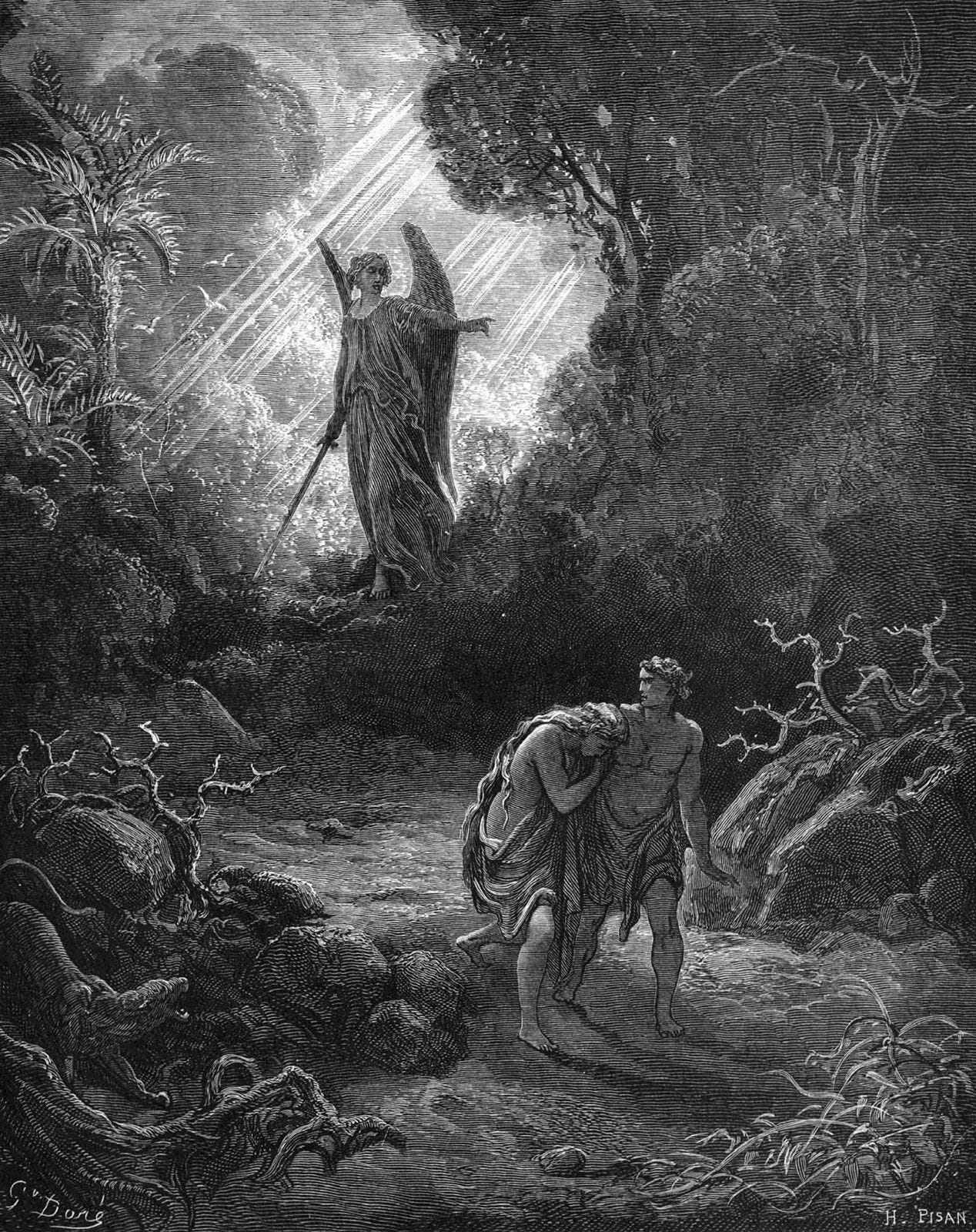
The Fall of Man — Gustave Doré (1866) Adam and Eve Driven out of Eden, wood engraving by Gustave Doré. From The Doré Bible Gallery (1892)
Gustave Doré’s engraving The Fall of Man clearly allows for Auerbach’s reading through the perspective of the biblical epic. Adam and Eve are not presented merely as mythological figures, but as characters confronting the rupture of the human condition.
Through the way they walk—especially in the gesture of their hair and garments, Eve’s bowed spine, and her downward-turned face—we perceive that both are conscious of a tragedy. This tragedy also manifests itself in the trunks, roots, trees, and stones of a nature stripped of exuberance, covered by the shadows of both the environment and their own consciousness.
The event carries a universal historical consequence, and the composition is divided between light and shadow: on one side, the presence of the angel and animal life in the background; on the other, in the foreground, the consequences of the committed act. The image does not represent an isolated episode, but a founding event whose effects extend across all human history.
There is also a kind of “pendulum” difference between the two narrative forms in the relationship between grandeur and humiliation. In Homer, characters, as bearers of divine will, are fallible and subject to misfortune and humiliation; however, within this condition, there is also the manifestation of divine sublimity. Yet they rarely suffer as profoundly as a biblical Adam, and rarely are left without direct divine intervention or inspiration.
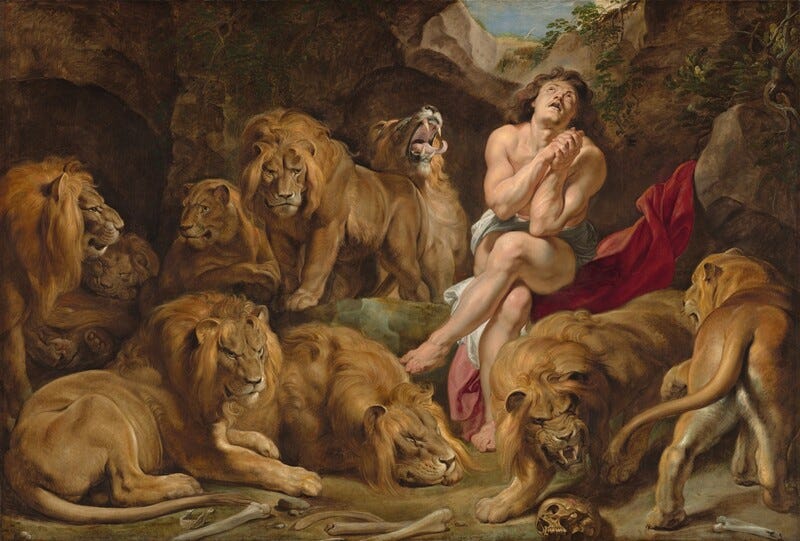
Nicolas Brenet (1728–1792), France — The Blessing of Jacob
In Brenet’s painting of the blessing of Jacob, the character who deceives his blind father looks directly into the father’s eyes, which are lost in the distance. At the same time, in a moment of surprise, the elder brother recognizes that he has been deceived. The presence of two light planes dividing the composition between the main scene and the adjacent scene introduces two narrative layers of psychological density.
This density is expressed both in the granting of the blessing by the blind father, while the son holds his garment, and in the reaction of the betrayed brother as he realizes the loss of his birthright. The painting thus constructs a narrative marked by the inner tension of its characters, in which the visible event is accompanied by moral and emotional conflicts unfolding simultaneously.
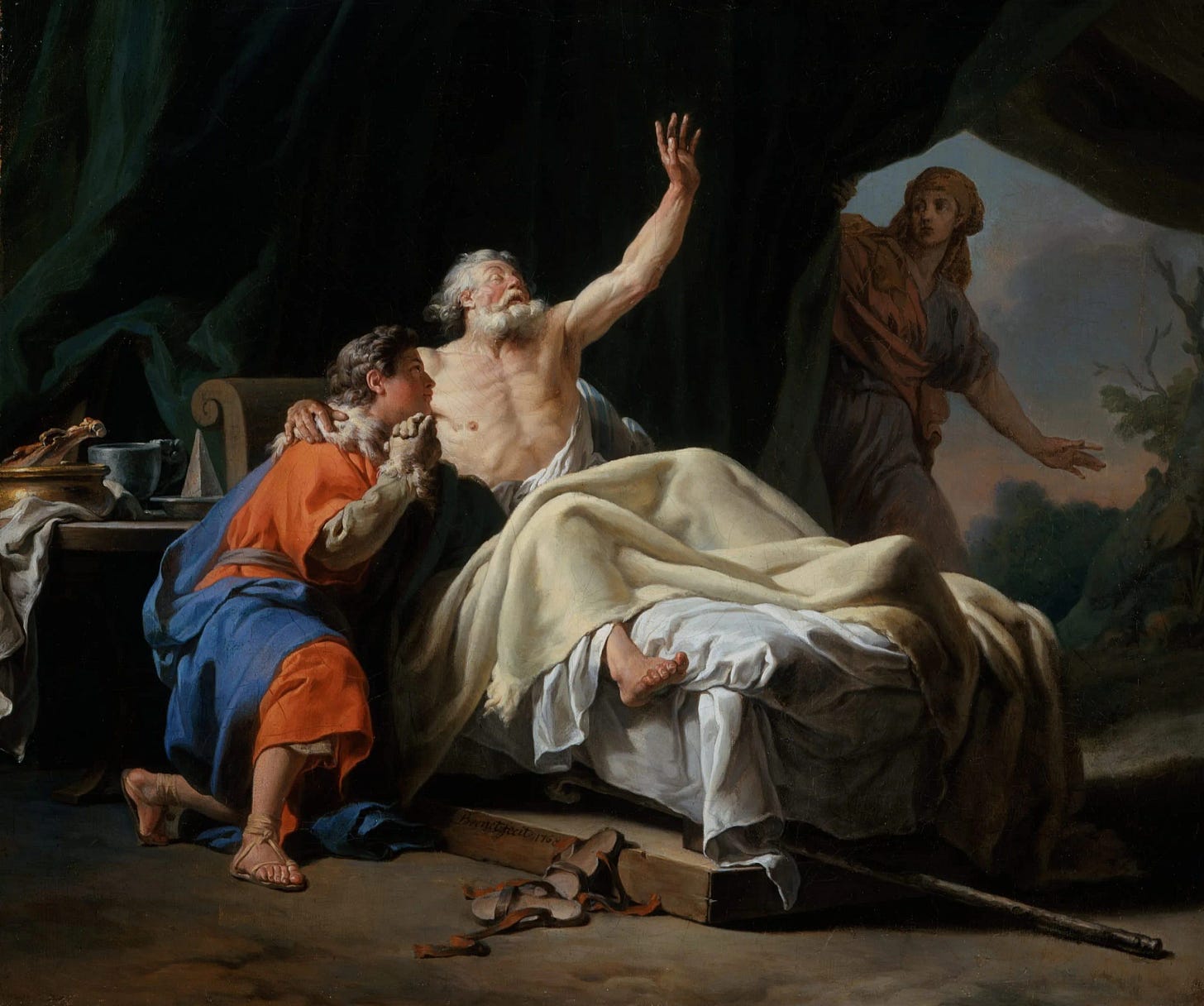
The Prophet Daniel in the Lions’ Den — Peter Paul Rubens (1614–1616)
In The Prophet Daniel in the Lions’ Den, by Rubens, Daniel is represented at the threshold between life and death, that is, in an extreme and abyssal situation. The tension lies not only in physical danger, but also in the relationship between faith, abandonment, and divine intervention.
The character’s body is entirely contorted, and through his desperate gaze he appeals for an answer that comes from beyond himself. The aggression and agitation of the animals are expressed through the contrasts of light and shadow and through the movement of their bodies, which echo the dynamism of Daniel’s red garment.
The composition intensifies the drama of the scene by simultaneously representing the threat of death and the hope of salvation, thereby conferring upon the episode a profound spiritual dimension.
The author uses the example of Ulysses, who disguises himself as a beggar; in other words, it is a case of pretending rather than a complete transformation into a beggar. Penelope’s age is of little importance to her representation after twenty years, in contrast to Jacob’s cunning attempt to obtain the blessing of the firstborn (AUERBACH, 2013, p. 14).
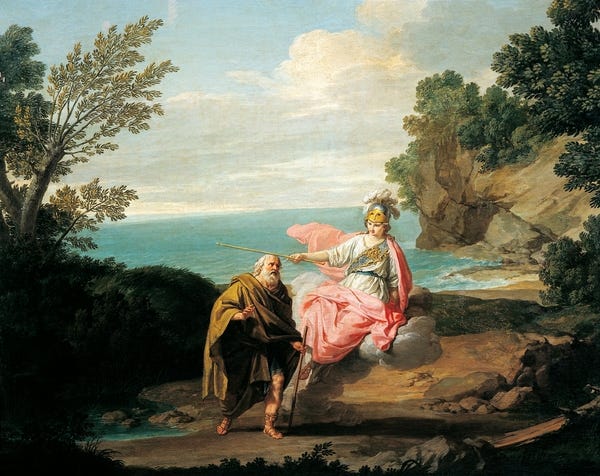
Ulysses Transformed into a Beggar by Athena — Giuseppe Bottani (1775)
Ulysses transformed into a beggar by Athena — Giuseppe Bottani. From an Auerbachian reading, this scene reveals a Homeric mixture. The transformation is purely external: it is only appearance. There is no sign of bodily decline, no sense of aging or environmental weight in this descent. Instead, it is a new garment over an unchanged heroic core, and the heroic element persists within the attire granted by the goddess, unfolding in a bucolic landscape.
Unlike biblical figures, there is no existential rupture or inner devastation in the transformation itself; it remains a visible and reversible disguise rather than a profound ontological change.
In contrast, in The Prophet Daniel in the Lions’ Den by Rubens, Daniel is represented at the threshold between life and death, that is, in an extreme and abyssal condition. The tension is not limited to physical danger, but extends to the relationship between faith, abandonment, and divine intervention.
The character’s body is fully contorted, and through his upward-directed gaze he calls for an answer that comes from beyond his earthly condition. The aggression and agitation of the lions are expressed through the contrasts of light and shadow, as well as through the movement of their bodies, which follows the dynamism of the red cloth enveloping Daniel.
The composition intensifies the drama of the scene by simultaneously representing the threat of death and the hope of salvation. Thus, the episode acquires a profound spiritual dimension: Daniel is abandoned to the forces of nature, yet sustained by faith in a divine intervention that transcends immediate danger.
For Auerbach, the Bible unfolds as:
“stories of personalities shaped as models of those whom God has chosen for the performance of exemplary roles.” (AUERBACH, 2013, p. 15)
These are figures who are bent, transformed, and tested by God, not merely blessed.
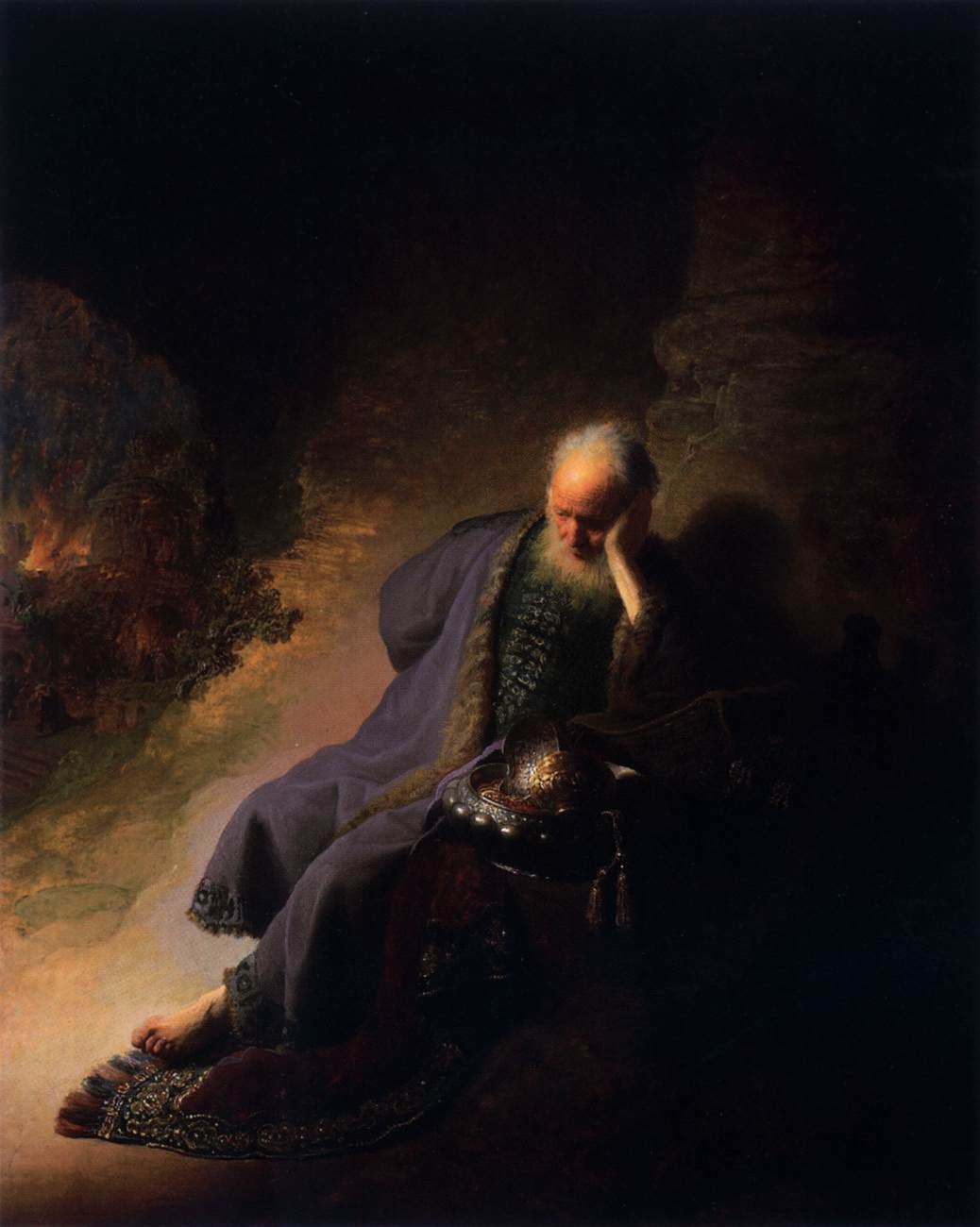
Jeremiah Lamenting the Destruction of Jerusalem — Rembrandt (1630) Oil on panel, 58 × 46 cm, Rijksmuseum, Amsterdam
In Jeremiah Lamenting the Destruction of Jerusalem, Rembrandt concentrates the interiority of historical sorrow in the figure of the prophet. Individual suffering becomes a reflection on collective destiny. Once again, Rembrandt uses shadows to evoke a sense of the hidden, the nebulous, and psychological drama, while simultaneously elevating the heroic-biblical figure through highlights on precious objects, fabrics, and details, even as the hero appears aged and with a deeply weary expression.
These figures, as Auerbach states, “are bearers of divine will, and yet they are fallible, subject to misfortune, and through their actions and words, to the sublimity of God” (AUERBACH, 2013, p. 15).
Humiliation and exaltation are far more profound or elevated than in Homer and, fundamentally, occur together. Biblical characters are both granted grace and tested by divine will.
The examples are numerous:
“Jacob is truly a fugitive, and Joseph is truly thrown into a pit and sold into slavery.” (AUERBACH, 2013, p. 15)
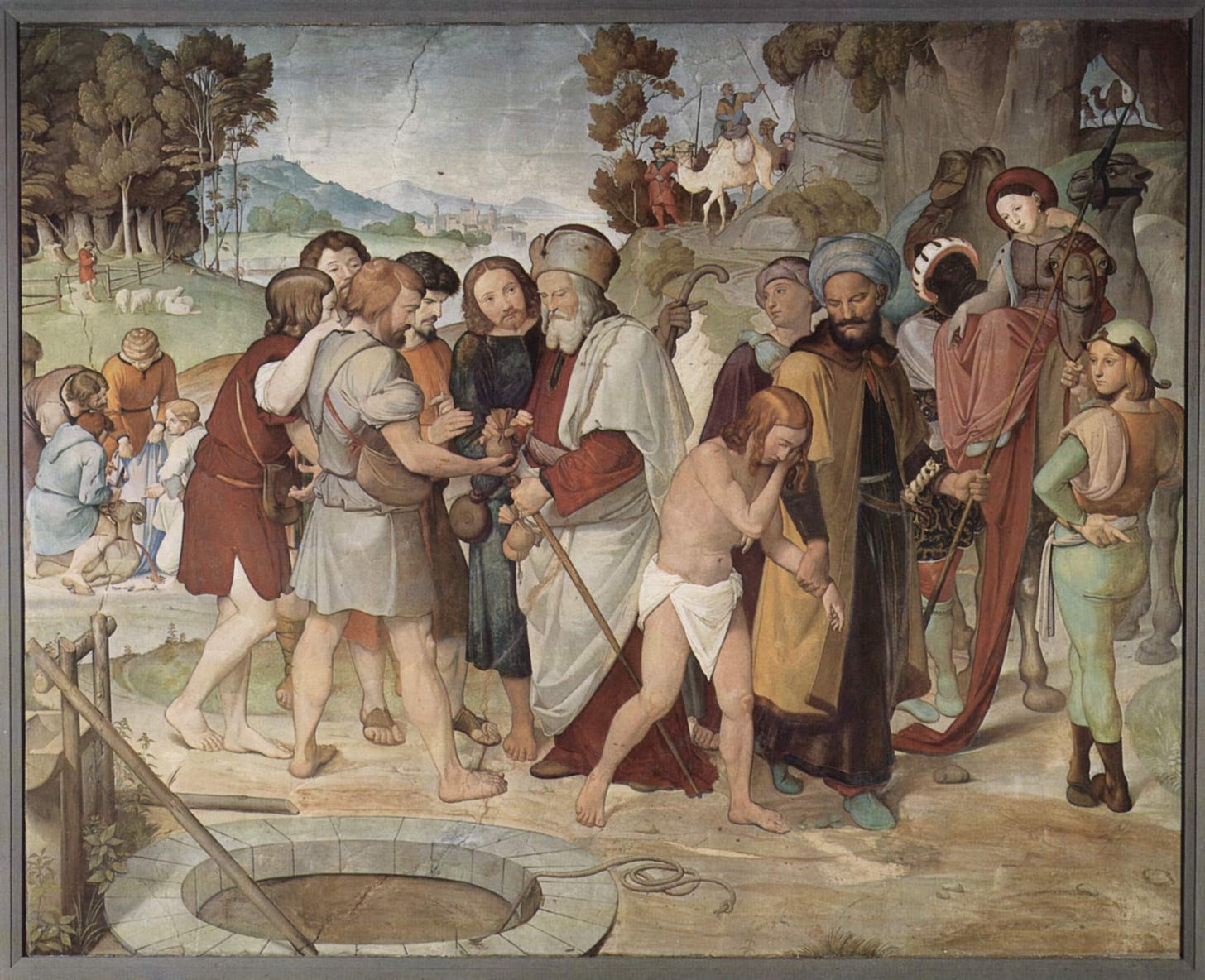
Joseph Sold by His Brothers — Friedrich Overbeck (1816–17)
In Friedrich Overbeck’s painting Joseph Sold by His Brothers, the biblical episode presents conflict, betrayal, and destiny. The biblical narrative creates depth because the present event is linked to a promised future. However, what is particularly notable in this representation is that each action of the characters is clearly and carefully constructed, without the mysterious or nebulous concealments found in Rembrandt’s use of shadow.
What the artist employs as a device in this composition is the gestural movement of the figures and the expression of sorrow on Joseph’s face. Although the bodies move with grace—slow and dignified—Joseph remains bowed, while the man receiving payment from Joseph’s brothers appears thoughtful. The buyer tightens his grip on the brothers’ hands with firmness. The subtle variations in facial expression introduce a renewed sense of psychological drama into the scene.
Greatness emerges precisely through humiliation itself; in situations of trial and extreme abandonment, a richer form of existence develops, moving away from the legendary toward the historical, as occurs in the narrative of David and Goliath (AUERBACH, 2013, p. 15).
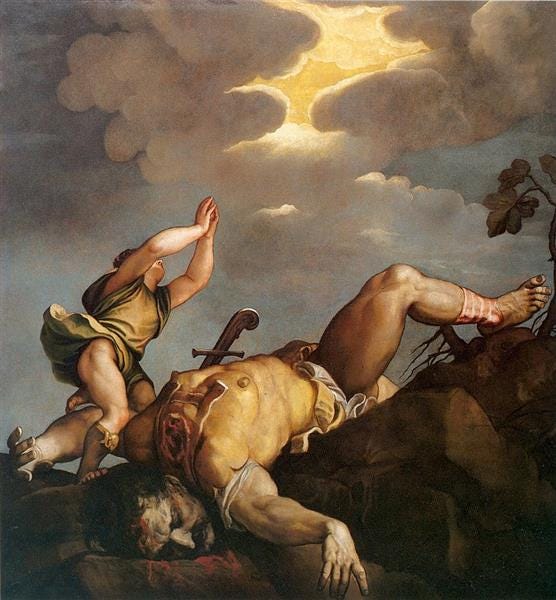
Titian — David and Goliath (1542–1544) Oil on wood. Basilica di Santa Maria della Salute, Venice, Italy. 300 × 285 cm
In David and Goliath by Titian, an Auerbachian reading reveals a classical Christian epic. Does David assume the characteristics of an epic hero? No. He possesses only the strength of a boy who cries out to the heavens for the miracle of his victory. The monumental body is that of the enemy, Goliath. The victory is visible only as a miracle of opposites, condensed into a single action in which God acts through the smallest and most fragile figure, demonstrating His power in the invisible. The greatness of the young hero arises from his relationship with God.
From this perspective, the author distinguishes between legend and historical account. The element of fidelity to reality as truth is what separates the two narrative forms, and the principle of unity emerges as a fundamental characteristic.
Auerbach states:
“Legend orders the subject in a univocal and decisive manner, detaching it from its remaining connections with the world so that the latter cannot interfere in a disruptive way; it knows only univocally fixed men, determined by few and simple motives, whose integrity of feelings and actions cannot be impaired.” (AUERBACH, 2013, p. 16)
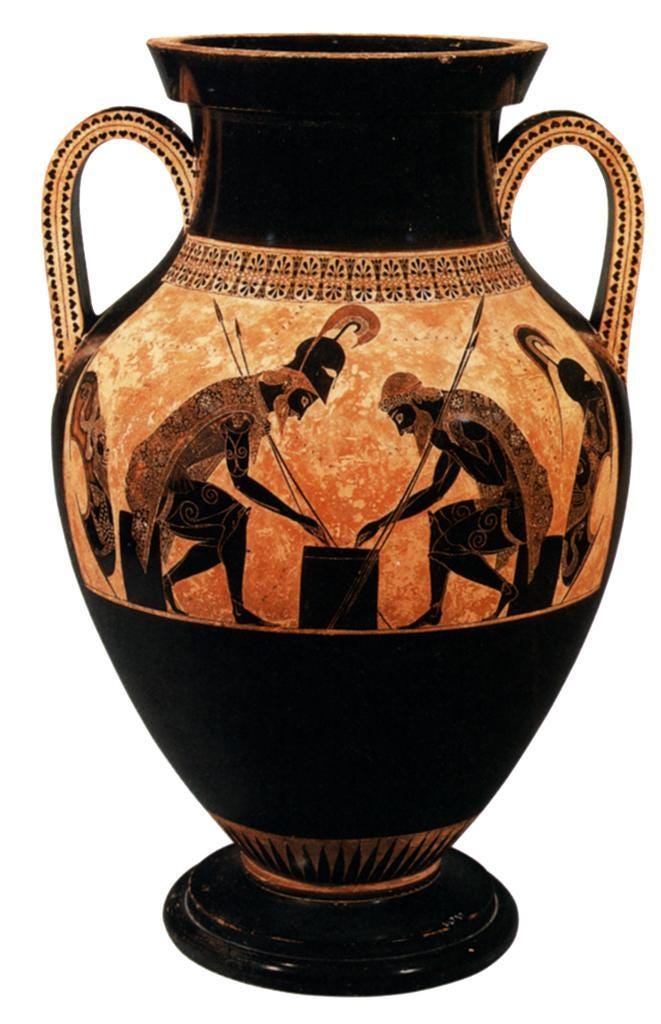
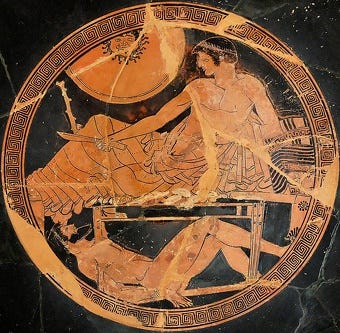
Ajax and Achilles — Exekias (c. 540–530 BCE) Ceramic amphora, Vatican Museums, Rome. Vulci; donated to Pope Gregory XVI by the Candelori brothers in 1834.
On the vase Ajax and Achilles by Exekias, an Auerbachian reading highlights the Homeric character of the epic. Even in a moment of rest, the heroes remain defined by their visible attributes: weapons, shields, and bodily posture. The heroic elements assert themselves as immediately recognizable through a fully externalized visual description.
There is also a strong sense of naturalness: no hidden interiority or psychological depth inaccessible to the viewer is present. Heroic identity is fully manifested on the surface of representation and remains unchanged even before battle. Achilles and Ajax are shown during a pause in the Trojan War, playing a game, with their hoplite shields placed beside them on both sides of the composition, reinforcing their martial identity even in leisure.
Exekias is considered one of the greatest artists of the black-figure technique of his period. Among his known works, he signed thirteen vases, acting as painter in only two of them. This piece is one of those signed works. The representation shows Ajax and Achilles during the Trojan War, within the narrative universe of the Iliad. Exekias identified the characters through inscriptions and also signed the piece at the lower section.
In Greek art, Achilles and Ajax are frequently represented with their weapons and armor, as in this amphora (COOKE, s.d., s.p.).
This amphora is also interpreted as a representation of Ajax in a moment of reflection before his suicide. The black-figure vase depicts one of the heroes of the Iliad, Ajax, and the scene is believed to relate to the period after the Trojan War. In the work, Ajax’s armor appears set aside on the right side, indicating vulnerability and exposure without the protection of the warrior.
This reading aligns well with Auerbach: the epic hero is defined by the exteriority of gestures, objects, and visible actions. Armor, shield, and bodily posture function as visual elements that reveal the character before any psychological interiorization.
By contrast, David as a biblical hero unites grandeur and humiliation, forming a different epic logic in which greatness emerges through suffering, testing, and divine relation rather than purely through external heroic presence.
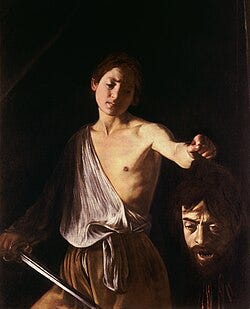
David with the Head of Goliath — Caravaggio (c. 1609–1610)
In David with the Head of Goliath, Caravaggio emphasizes an interior dimension. David does not appear merely as a victor, but as someone confronted with violence and death. The biblical hero is marked by consciousness.
Caravaggio represents David not only as a triumphant figure, but as someone standing before the reality of violence and mortality. Goliath’s severed head introduces a psychological dimension: it is not only heroic victory, but also a reflection on guilt, justice, and destiny.
In relation to Auerbach, greatness emerges through trial and humiliation. The biblical hero is constructed through suffering.
The author discusses the complexity of understanding the emotions of a people during the development of Nazism and how easily such digressions can be erased through a form of legendary historicism. While the biblical text, in Auerbach’s view, despite its inconsistencies in detail, always sustains a coherent historical body that defines its narrative and operates across at least three dimensions—legend, historical account, and exegetical theological history (AUERBACH, 2013, p. 18).
The author identifies a certain social immobility in Homeric narrative, where the only characters who appear as servants—Eurycleia and Eumaeus—do not possess personal feelings or independent interests, but instead embody a form of servitude tied to a senatorial or aristocratic order. The warriors themselves also belong to a superior category.
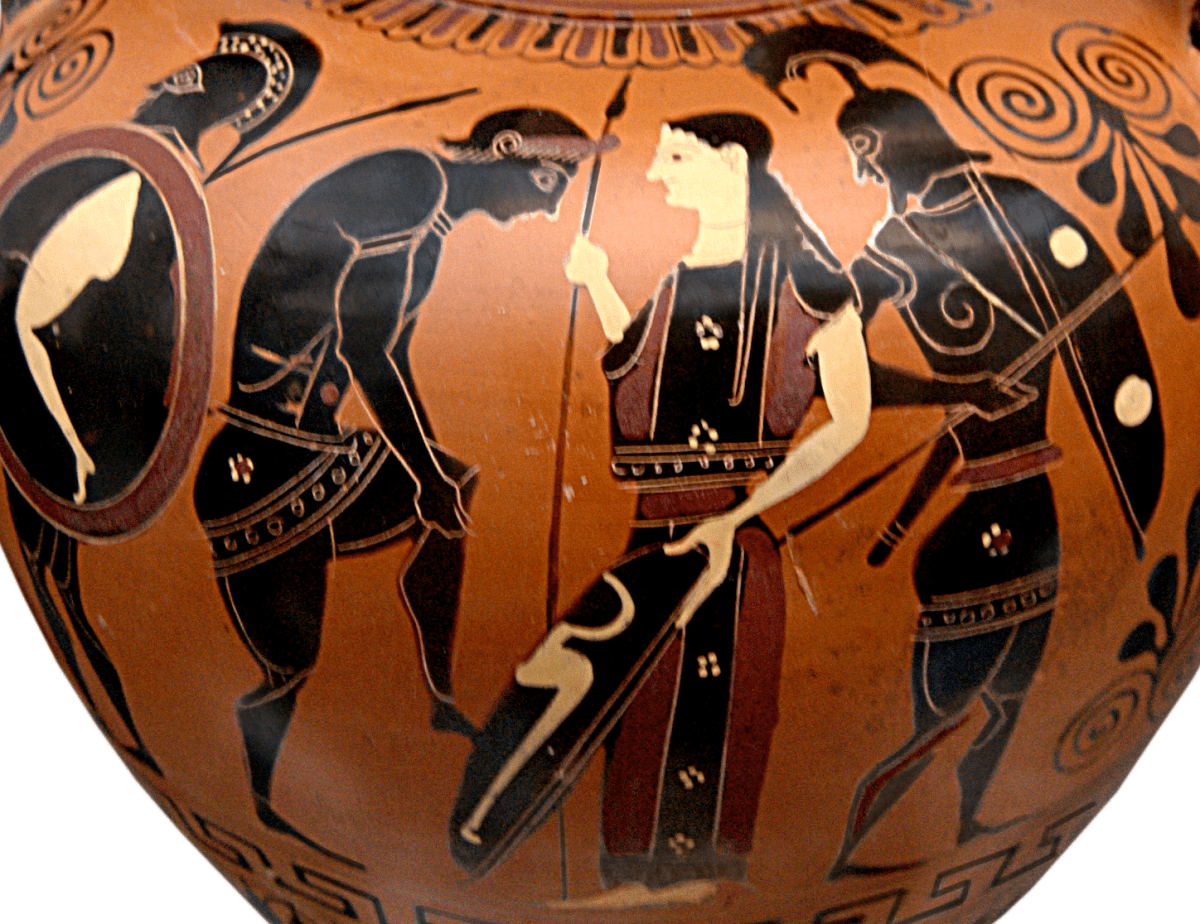
Lysippides Painter — Young Warrior Arming Himself with the Help of a Woman (c. 530 BCE) Detail of Attic black-figure amphora, attributed to the Lysippides Painter
In the vase Young Warrior Arming Himself with the Help of a Woman by the Lysippides Painter, we encounter an Auerbachian reading of the Homeric epic. The moment preceding battle transforms preparation itself into narrative action. Nothing is concealed: where there is war, there is also the visible process of preparation for it.
The warrior is constructed through equipment, body, and social function. There are no hidden emotions, no psychological dramas or internal conflicts surrounding the gesture of arming. The composition instead emphasizes the heroic body and the upright, dignified posture of the figure, while the female figure assists in equipping him, participating in the affirmation of martial destiny.
Heroism exists through visibility: armor, posture, and readiness for combat. Everything is fully externalized and immediately legible on the surface of the image.
In contrast, in the Old Testament, the patriarchal element presents a less stable framework, and after the departure of the Jewish people, prophecy emerges spontaneously from lower social classes and the people, introducing movement and depth within a kind of archaic democracy (AUERBACH, 2013, pp. 18–19).
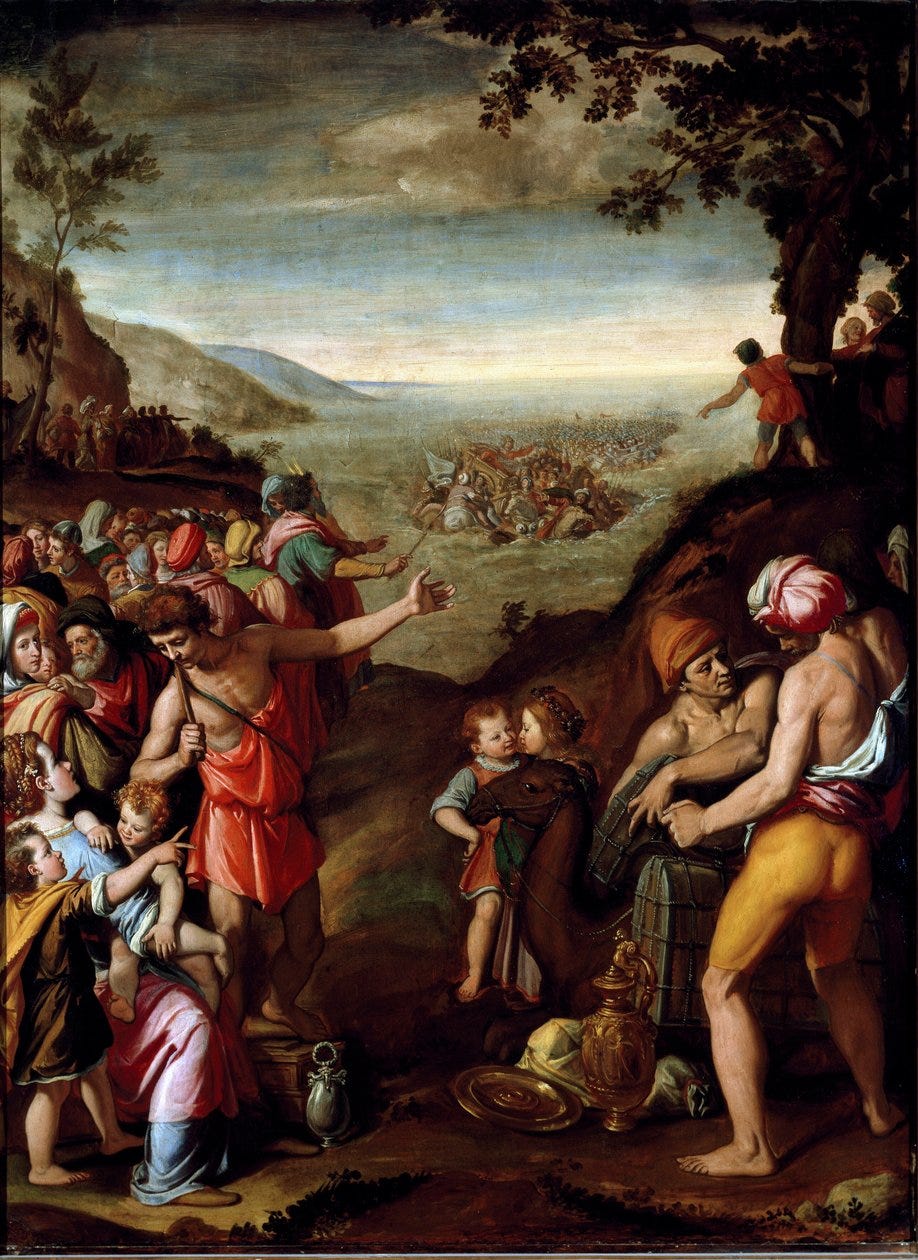
The Crossing of the Red Sea — Santi di Tito (1536–1603) Florence, Cabinet of François I, Palazzo Vecchio
In The Crossing of the Red Sea by Santi di Tito, we observe an Auerbachian reading of the collective biblical epic. Although the scene retains a certain monumentality comparable to the Homeric epic, the protagonist is not an individual hero, nor a member of the ruling class. It is a narrative of a people, of destiny, and of salvation.
Social stratification becomes visible within the same composition through details such as barefoot and shod figures, covered and uncovered bodies, and the representation of the less privileged alongside more dignified figures. At the same time, the artist constructs heroic bodies in a classical manner, emphasizing anatomy and physical presence.
Women and children occupy the center of the scene, not merely as decorative figures but as active participants in the narrative. Layers of shadow do not only construct perspective but also separate two planes: the Egyptian army drowning in the sea through divine intervention, and the Hebrew people—vast in number yet lacking warriors—witnessing salvation and illumination.
It is particularly significant that the painter places many women and children in positions of prominence, with men interacting with them through gestures of dialogue and equality. Elderly figures, young women, and children observe and participate without the need for a dominant heroic class to determine the outcome of the conflict.
Auerbach states:
“The deeper historicity and social mobility of the texts of the Old Testament (…) give rise to a concept of elevated style and sublimity different from that of Homer. Homer, indeed, does not hesitate to insert the everyday and realistic into the sublime and tragic…” (AUERBACH, 2013, p. 19)
For the author of Mimesis, when Homer presents the everyday element, it appears integrated into the idyllic and sublime, producing something peaceful and harmonious. In the Bible, however, in figures such as Adam, Noah, David, and Job, the sublime, the tragic, and the problematic are fused with everyday life.
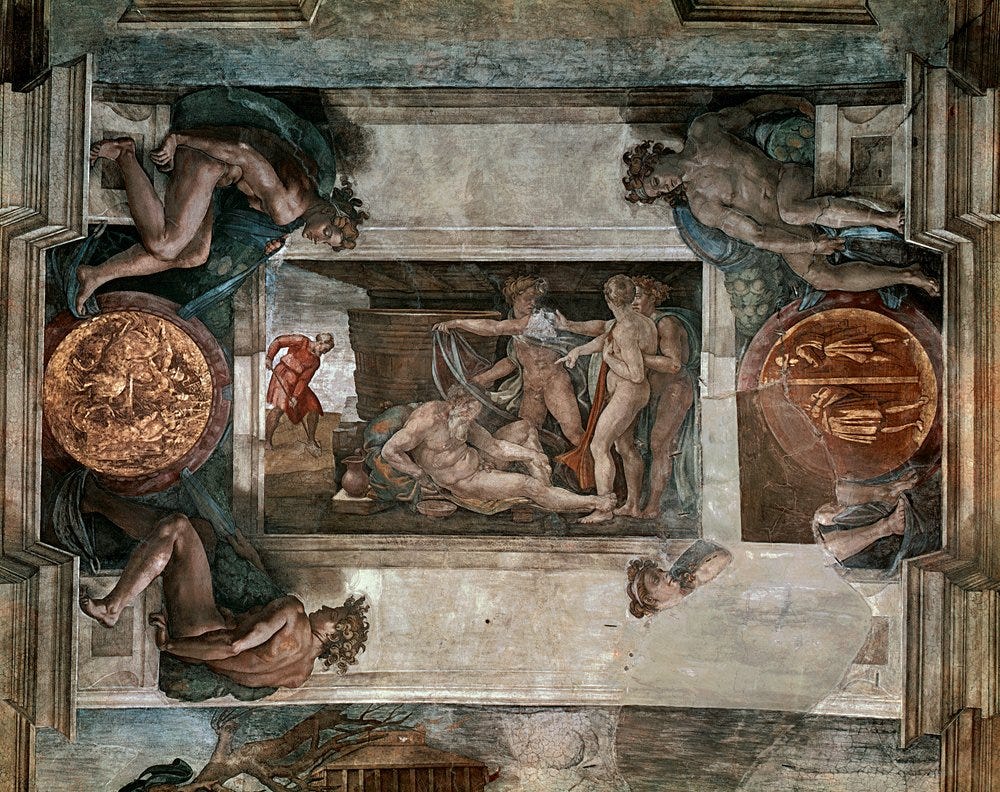
The Drunkenness of Noah — Michelangelo Buonarroti (1508–1512) Sistine Chapel, Vatican City
In The Drunkenness of Noah, Michelangelo represents Noah in an intensely human condition: vulnerable, intoxicated, and exposed before his family. The same man who previously saved humanity is now shown in a state of humiliation. Here lies precisely Auerbach’s point: the biblical character is not merely an idealized hero.
His sons reveal a deep interior psychology, expressing their sense of honor not in witnessing the father at his highest moment, but in confronting his vulnerability. Noah is marked by weakness, conflict, shame, and interiority. In a simple act of domestic life, we encounter fragility, shame, and the humanity of the biblical family. The sublime and the everyday coexist: the sublime does not eliminate the quotidian; it emerges from human fragility.
This gesture unfolds as one son attempts to cover his father’s nakedness, while another points at him in ridicule, and a third contemplates the scene in astonishment, as if it could be any one of us. A certain darkness envelops the bodies as it also envelops the psyche of the characters. Even if physically heroic in their anatomical representation—echoing a Homeric sensibility—these figures are immersed in a drama of interior gestures that obscure their faces in shadow.
It is a different origin of conflict: for Homeric heroes, conflict requires clear and defined pretexts, tangible events that lead to hostility or confrontation. In biblical figures, however, conflict also belongs to the psychological sphere, involving emotions such as jealousy, election, and the promise of blessing.
Everyday life is permeated by this conflictual substance, as an internal element that traverses the characters’ existence (AUERBACH, 2013, p. 19).
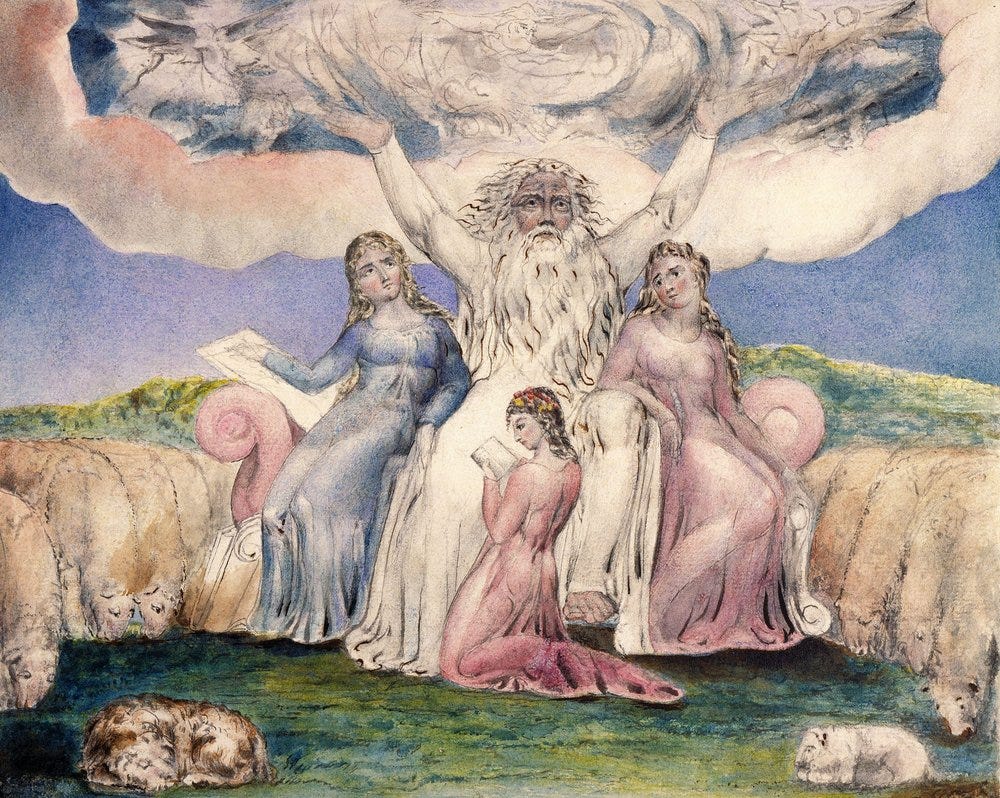
Job and His Daughters, William Blake, 1805
Job represents the deepest form of the biblical character: suffering; divine testing to determine whether he would truly stand with the Lord in the condition of humiliation; his relationship with God in the face of tragedy and redemption. The character undergoes an inner transformation from before the ordeal to after it, in relation to a faith that unfolds in multiple layers. In this work by William Blake, the use of light’s clarity does not become an element of transparency; instead, it renders the character’s hands, raised toward heaven in a cry for divine grandeur, somewhat nebulous. The conflict is existential, not merely narrative, where the character’s body merges with the celestial atmosphere itself.
The sublime intervention of God acts so deeply upon everyday life that the sublime and the ordinary come to coexist within the same narrative structure (AUERBACH, 2013, p. 19).
Job and his daughters — William Blake, 1805. The story of Job is perhaps one of the closest to Auerbach’s analysis: the character is placed before extreme suffering without immediate explanation. The drama lies not only in the external event, but in the internal conflict: faith, doubt, abandonment, and relationship with God. Relation to Auerbach: the biblical conflict is psychological and spiritual, unlike the Homeric epic conflict based on action and honor (i.a).
The author concludes his comparative analysis by establishing a difference between the styles:
On one side:
“Modeling description, uniform illumination, seamless connection, free speech, predominance of the foreground, univocity, limitation regarding historical development and the humanly problematic.” (AUERBACH, 2013, p. 20). Noting also the senatorial class in narrative dominance.
On the other side:
“Emphasis on certain parts and darkening of others, lack of connection, suggestive effect of the tacit, multiplicity of planes, multivocity and need for interpretation, claim to historical universality, development of the representation of historical becoming and deepening of the problematic.” (AUERBACH, 2013, p. 20). Archaic democracy and social mobility.
Regarding the pictorial analyses in the text: Exekias — Ajax and Achilles playing, c. 540–530 BC. Even outside battle, the heroes remain defined by exteriority: armor; shields; inscribed names; bodily posture. The image already reveals. The “modeling description,” “uniform illumination,” clear and closed identity, senatorial class.
Ulisses being recognized: Ulysses is a hero with a history, but the visual representation still privileges gesture; recognition; concrete and real action. Emotion appears in gesture, not in an interior psychological analysis, but as material recognition.
Jacques-Louis David’s neoclassicism in his depiction of the Anger of Achilles also reconstructs the epic in the Homeric style through clear lighting, temperate gestures, and the absence of obscurity or concealment of characters and actions.
The author defends the understanding of this limitation of the Homeric text also as a result of a historical process in the development of narrative forms and modes of writing. Therefore, the two texts should be read separately, as complete and self-contained works belonging to different forms of representing reality.
1. Homeric characteristics: exteriority, heroic body, action, and visible identityThe representations closest to the Homeric epic structure described by Auerbach are those in which character construction occurs through the clear exposition of body, gesture, and action. In the Homeric model, the hero is presented in his full visibility: attributes, social position, strength, and narrative function appear without psychological concealment.
In “Eurycleia discovers Ulysses,” the hero’s identity is not revealed through inner reflection but through physical recognition of the scar. The past becomes present through the body, as the material mark confirms who he is. Memory, in this case, does not belong to the psychological realm but appears as an external sign. Likewise, in “Ulysses and his father Laertes,” the reunion is constructed through the gesture of embrace and immediate recognition, following the epic logic in which feelings and relationships are revealed through visible actions.
In “Ajax and Achilles playing,” by Exekias, even outside combat, the heroes remain defined by external attributes: armor, shields, posture, and spatial position. The game does not erase heroic identity; on the contrary, it reaffirms it through visible elements. In “Young warrior arming himself with the help of a woman,” by the Lysippides Painter, preparation for battle transforms the body and military objects into central narrative elements.
In representations such as “Achilles and Hector,” the heroic dimension emerges from direct confrontation between bodies, weapons, and destinies. The scene organizes conflict through external action, approaching what Auerbach identifies as foreground narrative, uniform illumination, and absence of hidden zones. The same sense of repose in these bodies also enhances a bucolic and everyday appreciation characteristic of Homeric poetry.
In “Ulysses transformed into a beggar,” by Giuseppe Bottani, the Homeric element of strategy and external transformation persists: Ulysses remains the hero of intelligence and action. The disguise introduces an issue of mere appearance, as the artist depicts him as an old man without deep signs of aging or psychological burden, only enlarged garments and white beard, a fantasy also shaped by Athena’s heroic presence.
In “The Love of Helen and Paris,” by Jacques-Louis David, even though passion is a deeply human experience, the lovers do not display any drama beyond the luminosity of their bodies within a sumptuous palace. Neoclassical style removes emotional complexity and instead offers the aesthetic pleasure of palace representation and beautiful fabrics and bodies.
2. Biblical characteristics: depth, interiority, silence, and destinyBiblical structures of representation approach Auerbach’s narrative model because in them the visible event always points to an inner and symbolic dimension. The biblical character is defined not only by what they do, but by the conflict they carry, the weight of choice, and their relationship with a higher order.
In “Abraham and Isaac” by Rembrandt and Jan Lievens, the dramatic center is not only the external act of sacrifice, but Abraham’s moral and spiritual tension. Unlike the Homeric hero, whose crisis unfolds in public action, the biblical character is traversed by an invisible conflict: obedience, doubt, suffering, and belief. These scenes employ strong contrast and atmospheric darkness, creating a visual reality of drama.
In “The Fall of Man” by Gustave Doré, Adam and Eve represent not merely a narrative moment but a rupture that transforms human condition. The episode gains universal dimension, as the individual event becomes part of a greater history. Doré also constructs a darkened environment using roots and shadows to symbolize destruction and fall, while the angel occupies a lighter, luminous space.
This depth also appears in “The Drunkenness of Noah” by Michelangelo, where the biblical figure is not only a patriarch but a vulnerable man. The sublime and the ordinary coexist. In “Daniel in the Lions’ Den” by Rubens, “Jeremiah Lamenting the Destruction of Jerusalem” by Friedrich Overbeck, “The Crossing of the Red Sea,” and “Job and His Daughters” by William Blake, the narrative is built through suffering, trial, and the relationship between the individual and destiny. Faces and expressions intensify emotion, while light and shadow function as instruments that create and conceal dramatic atmosphere.
The transformation becomes even clearer in “David and Goliath” by Titian and “David with the Head of Goliath” by Caravaggio. The biblical character assumes classical heroic features: monumentality appears in the oversized body of Goliath, often emphasized through low-angle perspective, while victory is expressed through gesture and divine grace. Grandeur lies not only in physical strength but in the spiritual meaning of the event.
In Caravaggio in particular, victory does not eliminate psychological complexity: gaze, expression, and the relationship between victor and vanquished introduce guilt, reflection, and humanity.
3. Transformation of classical tradition: between Homeric heroism and biblical depthSome works do not belong exclusively to one model, as they demonstrate the historical process through which Western art absorbs the classical epic structure and transforms it through a Christian vision of existence.
In Felice Giani’s “The Dispute between Achilles and Agamemnon,” the conflict still belongs to the Homeric universe of honor and rivalry among warriors. However, the artist introduces figures such as Athena and Briseis, adding a subtle psychological layer that brings the ancient hero closer to a modern understanding of individuality.
Friedrich Overbeck’s “Joseph Sold by His Brothers” presents clarity in gestures and composition, while psychological depth emerges in Joseph’s bowed and sorrowful body. The surrounding environment remains natural and calm, closer in some aspects to Homeric clarity, while still allowing emotional nuance through gesture and expression.
Thus, these works demonstrate that Western artistic tradition does not simply separate Homeric epic from biblical narrative, but constantly mixes them. Classical monumentality remains, yet it is transformed by Christian interiority, producing figures who are simultaneously heroes of action and figures of suffering, consciousness, and destiny.
ConclusionThe comparison between these representations shows that Auerbach’s categories are not rigid divisions but narrative modes that traverse different periods in art history. The Homeric tradition organizes epic through immediate bodily presence, gesture, and action, constructing characters defined by exteriority and social order.
The biblical tradition shifts narrative focus toward interiority, moral conflict, and what remains hidden. Christian painting develops tools such as shadow, light, silence, and facial expression to reveal a psychological dimension absent from the Homeric model.
Painting, by absorbing these two narrative forms, creates its own language capable of uniting the heroic monumentality of classical tradition with the spiritual depth of biblical tradition. The heroic body remains as a legacy of Greek art but comes to represent fall, sacrifice, redemption, and transcendence. Epic imagery, therefore, is not limited to the representation of great deeds, but becomes a space where different conceptions of humanity enter into dialogue: the hero facing external forces and the individual confronting inner conflicts.
(AUERBACH, Erich. Mimesis: The Representation of Reality in Western Literature. São Paulo: Perspectiva, 2013.)
IMAGE REFERENCESLeutemann, Heinrich. Ulysses’ wet nurse Eurycleia recognizes her lord. 1880. Wood engraving. Illustration based on an episode from Homer’s Odyssey. Available at: https://www.istockphoto.com/br/vetor/enfermeira-ulysseswet-euricleia-reconhecer-o-lord-a-mitologia-grega-gm538670554-95856335. Accessed: June 20, 2026.
Unknown Author. Ulysses and his father Laertes, King of Ithaca. 2nd century CE. Marble relief fragment of a Roman sarcophagus. Museo Barracco, Rome, Italy. Available at:
https://www.museobarracco.it/
. Accessed: June 20, 2026.
Rembrandt Harmenszoon van Rijn. Abraham and Isaac. 1645. Oil on canvas. Available at: https://www.metmuseum.org/art/collection/search/437397. Accessed: June 20, 2026.
Rembrandt Harmenszoon van Rijn. The Sacrifice of Isaac. 1635. Oil on canvas. Available at:
https://www.hermitagemuseum.org/
. Accessed: June 20, 2026.
Lievens, Jan. Abraham and Isaac (The Sacrifice of Isaac). c. 1637–1638. Oil on canvas. Herzog Anton Ulrich Museum, Braunschweig. Available at: https://3landesmuseen-braunschweig.de/en/herzog-anton-ulrich-museum. Accessed: June 20, 2026.
David, Jacques-Louis. The Anger of Achilles. 1819. Oil on canvas. Musée du Louvre, Paris. Available at:
https://collections.louvre.fr/
. Accessed: June 20, 2026.
Giani, Felice. The Dispute between Achilles and Agamemnon. c. 18th–19th century. Painting. Available at:
https://www.wga.hu/
. Accessed: June 20, 2026.
David, Jacques-Louis. The Love of Helen and Paris. 1788. Oil on canvas. Musée du Louvre, Paris. Available at:
https://www.louvre.fr/
. Accessed: June 20, 2026.
Doré, Gustave. Adam and Eve Driven Out of Eden. 1866. Wood engraving. In: The Doré Bible Gallery (1892). Available at: https://www.gutenberg.org/ebooks/8710. Accessed: June 20, 2026.
Rubens, Peter Paul. Daniel in the Lions’ Den. 1614–1616. Oil on canvas. National Gallery of Art, Washington, D.C. Available at: https://www.nga.gov/collection/art-object-page.46440.html. Accessed: June 20, 2026.
Bottani, Giuseppe. Ulysses Transformed into a Beggar by Minerva. 1775. Painting. Available at:
https://www.wga.hu/
. Accessed: June 20, 2026.
Rembrandt Harmenszoon van Rijn. Jeremiah Lamenting the Destruction of Jerusalem. 1630. Oil on panel. Rijksmuseum, Amsterdam. Available at: https://www.rijksmuseum.nl/en/collection/object/Jeremiah-Lamenting-the-Destruction-of-Jerusalem--8e1adedeb8e339890121dc4228dce95d. Accessed: June 20, 2026.
Overbeck, Friedrich. Joseph Sold by His Brothers. 1816–1817. Painting. Available at:
https://www.wga.hu/
. Accessed: June 20, 2026.
Exekias. Ajax and Achilles Playing a Game. c. 540–530 BCE. Black-figure pottery. Vatican Museums, Rome. Available at:
https://www.museivaticani.va/
. Accessed: June 20, 2026.
Cooke. Black-Figure Art from Ancient Greece: Ajax and Achilles. Scalar, University of Southern California. Available at: https://scalar.usc.edu/works/ancient-art/cooke----black-figure-art-from-ancient-greece-1.12. Accessed: June 18, 2026.
Caravaggio, Michelangelo Merisi da. David with the Head of Goliath. c. 1609–1610. Oil on canvas. Galleria Borghese, Rome. Available at: https://borghese.gallery/collection/paintings/david-with-the-head-of-goliath.html. Accessed: June 20, 2026.
Michelangelo Buonarroti. The Drunkenness of Noah. 1508–1512. Fresco. Sistine Chapel, Vatican City. Available at: https://www.michelangelo.org/drunkenness-of-noah.jsp. Accessed: June 20, 2026.
William Blake. Job and His Daughters. 1805. Watercolour. Tate Gallery, London. Available at:
https://www.tate.org.uk/
. Accessed: June 20, 2026.
Santi di Tito. The Crossing of the Red Sea. 16th century. Painting. Palazzo Vecchio, Florence. Available at:
https://musefirenze.it/
. Accessed: June 20, 2026.
Titian (Tiziano Vecellio). David and Goliath. c. 1542–1544. Oil on wood. Basilica of Santa Maria della Salute, Venice. Available at:
https://www.wga.hu/
. Accessed: June 20, 2026.
Michelangelo Buonarroti. The Sistine Chapel Ceiling (cycle). 1508–1512. Frescoes. Vatican City. Available at:
https://www.vatican.va/
. Accessed: June 20, 2026.